Work & Money
She was scouted for the stage. He wanted her behind the counter
My grandma would be 100 next year. And when I picture her as a young woman, I picture her alive - moving, speaking, taking up space. The version of her that existed before life narrowed into duty and practicality and “what makes sense.” My mum told me this story like it was just a fact […]
By Lucy · 6 August 2026
My grandma would be 100 next year.
And when I picture her as a young woman, I picture her alive – moving, speaking, taking up space. The version of her that existed before life narrowed into duty and practicality and “what makes sense.”
My mum told me this story like it was just a fact of the family, something you file away under that’s how it was back then. But… it doesn’t feel like “back then” when you actually sit with it. It feels like a blueprint. Like a script that gets handed down.
So here it is.
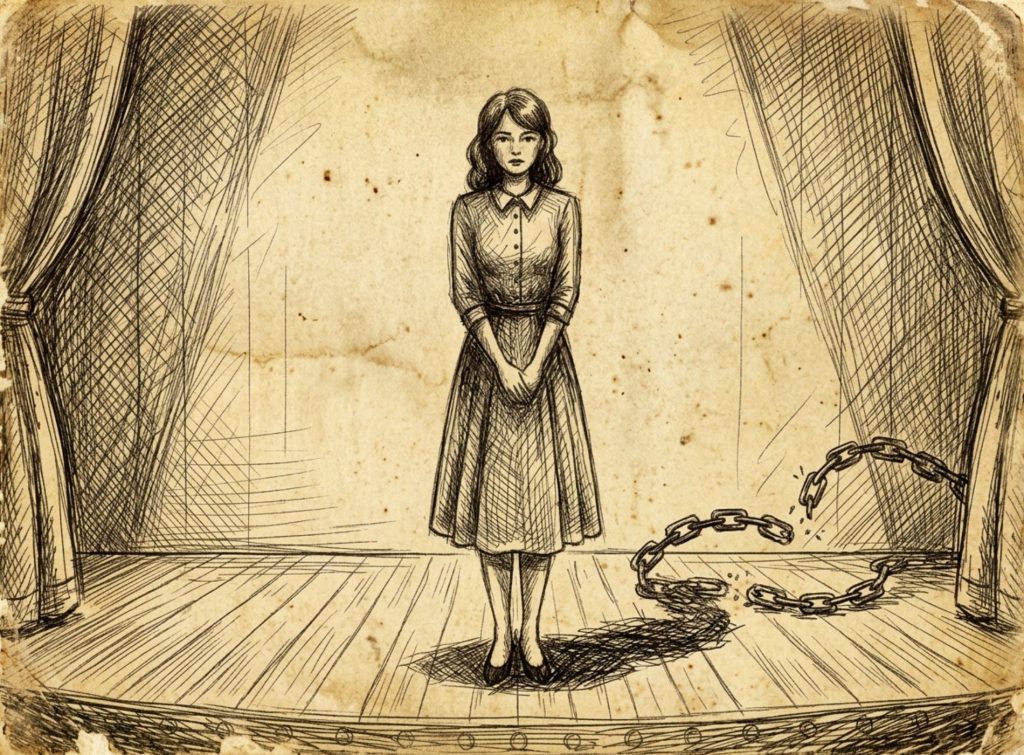
My grandma was performing at a theatre when someone noticed her. A scout. The kind of moment people wait their whole lives for without even knowing they’re waiting. They wanted her to go to London. To train. To work. To act.
And then her dad stepped in.
Not with a discussion. Not with curiosity. Not with “tell me what YOU want.”
With a sentence that ended it.
“No daughter of mine is going to London and working in the theatre.”
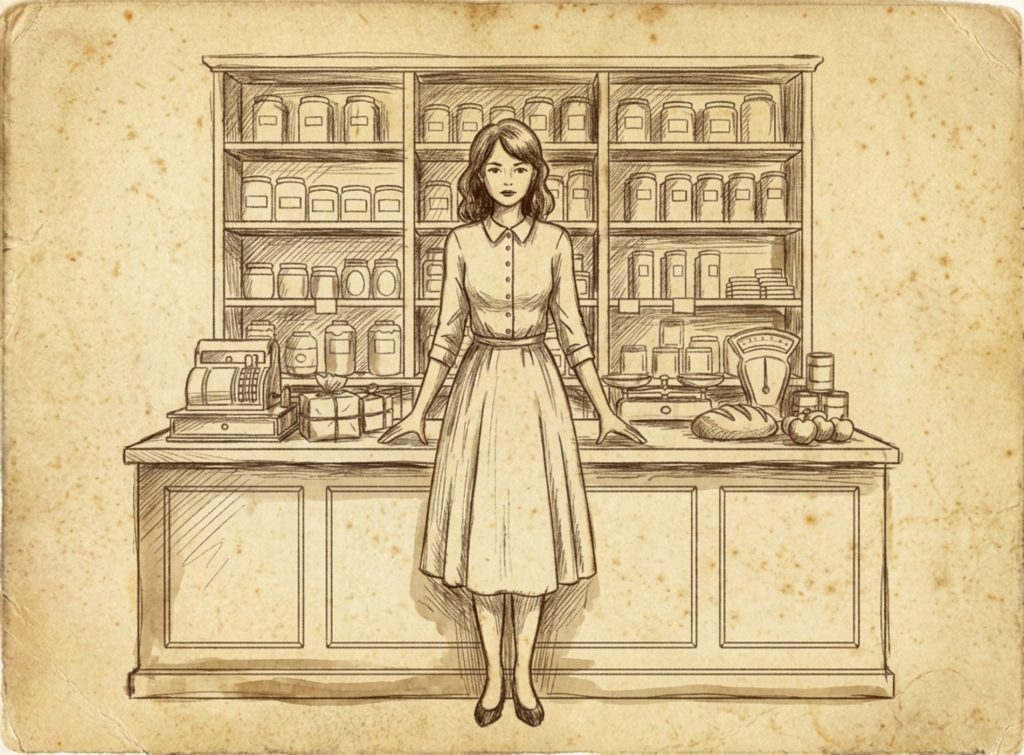
He had a different plan for her. His corner shop. A practical life. A respectable life. A life that stayed close. A life that was useful to the family.
And I know what you might be thinking – different time, different world. Totally. And also… are we sure we’ve moved on as much as we think we have?
Because this is the thing: it wasn’t really about theatre.
It was about risk.
It was about visibility.
It was about a daughter becoming someone the family couldn’t fully manage.
The corner shop wasn’t just a job. It was containment. It was “stay where we can see you.” It was “be sensible.” It was “don’t embarrass us.” It was “don’t want too much.” It was “don’t go too far.” It was “don’t become a story we can’t control.”
And yes, if you zoom out, you can find compassion for the fear behind it. Families who lived closer to scarcity often treated safety like the highest form of love. Respectability like armour. Predictability like protection.
But still.
Imagine being told your talent is real – real enough that a stranger wants to open a door for you – and then being told it doesn’t matter because you belong somewhere else.
And what gets me is how familiar this still is.
Maybe the details change. Maybe it’s not London and theatre and a corner shop. Maybe it’s “that’s not a real degree,” or “you’ll never make money doing that,” or “people like us don’t do those jobs,” or “you’re too smart to waste yourself on something creative,” or “choose something stable first.”
But the message underneath is the same:
Choose what makes us feel safe, not what makes you feel alive.
And here’s where it turns from a historical story into a living one.
Because the irony is: this didn’t end with my grandma.
My mum experienced it too, with her dad.
The same man who was married to my grandma, the same family line, the same shape of sentence.
In the 70s, my mum wanted a different path, and he told her: No daughter of mine is going to be a farmer.
So she was pushed, bullied, really, into nursing. The respectable choice. The approved choice. The choice that sounded good when you told other people. The choice that made the family feel proud and safe and certain.
And just to be clear: I’m not saying nursing isn’t meaningful. I’m saying it matters whether it’s chosen from desire or chosen from pressure. Whether it’s a calling or a compromise. Whether it’s a “yes” or a “fine.”
What I’m watching, across three generations, is how easily love gets tangled up with control. How often “I want the best for you” becomes “I want you to do what I can understand.” How quickly a family can mistake financial security for emotional safety, and then build a boundaries-for-busy-women" class="pb-autolink" title="How to Stop Work Eating Your Whole Life in Your 40s">whole life around that mistake.
And I think that’s why this story is hitting me so hard right now, because I’m in a season of choosing again.
I recently quit my own business, impulsively, because it wasn’t serving me anymore. (Yep. One of those “I can’t do this another year” moments.) And it’s been confronting and clarifying at the same time. Like pulling a thread and realising it was stitched through everything.
For the last two decades, I think I forgot who I was. Or maybe I just got very good at being practical. At being sensible. At doing what made sense on paper.
And now, slowly but surely, I’m coming back to myself… back to my creativity, back to making things, back to selling what I make. Back to the part of me that feels most alive when I’m creating.
So when I think about my kids and careers, it isn’t just a theoretical parenting debate. It’s personal.
My husband has said on numerous occasions that he wants our kids to pursue certain careers mainly for the financial aspect – good earners, sensible paths, secure futures. And I understand the instinct. The world is expensive. Nobody wants their children to struggle.
But I also know – deep in my bones – that a life you don’t love has a cost too.
And I don’t fully know yet where the line is. How to hold both truths at once:
That financial stability matters.
And that a life you don’t love has a cost too.
That some careers open doors.
And that forcing a child into a door they didn’t choose can quietly close something inside them.
That we want to protect our kids.
And that protection can become a cage if we’re not careful.
Maybe this is what it means to break a cycle, not by villainising the people who came before, but by noticing the pattern early enough to choose differently.
To ask better questions than “what job will make you money?”
Questions like:
What makes you feel most like yourself?
What are you curious about even when nobody is watching?
What kind of problems do you want to solve?
What kind of life do you want to build around your work?
What would you do if you knew you were allowed?
Because a century ago, my grandma was offered a doorway and got steered back into a corridor.
And I keep thinking: if we’re not intentional, we’ll keep doing that, just with updated language.
Journaling prompts (if this resonates):
- What did my family define as a “respectable” career, and what did they quietly dismiss?
- Where do I confuse safety with smallness?
- What is my “London” (the thing I want that feels too big, too far, too risky)?
- What’s the cost of choosing only what makes sense on paper?
- If I could design a “both/and” future (meaning + money), what would it look like?
- What do I want my kids to believe about work, worth, and freedom?